❮
![Large Image]() ❯
❯
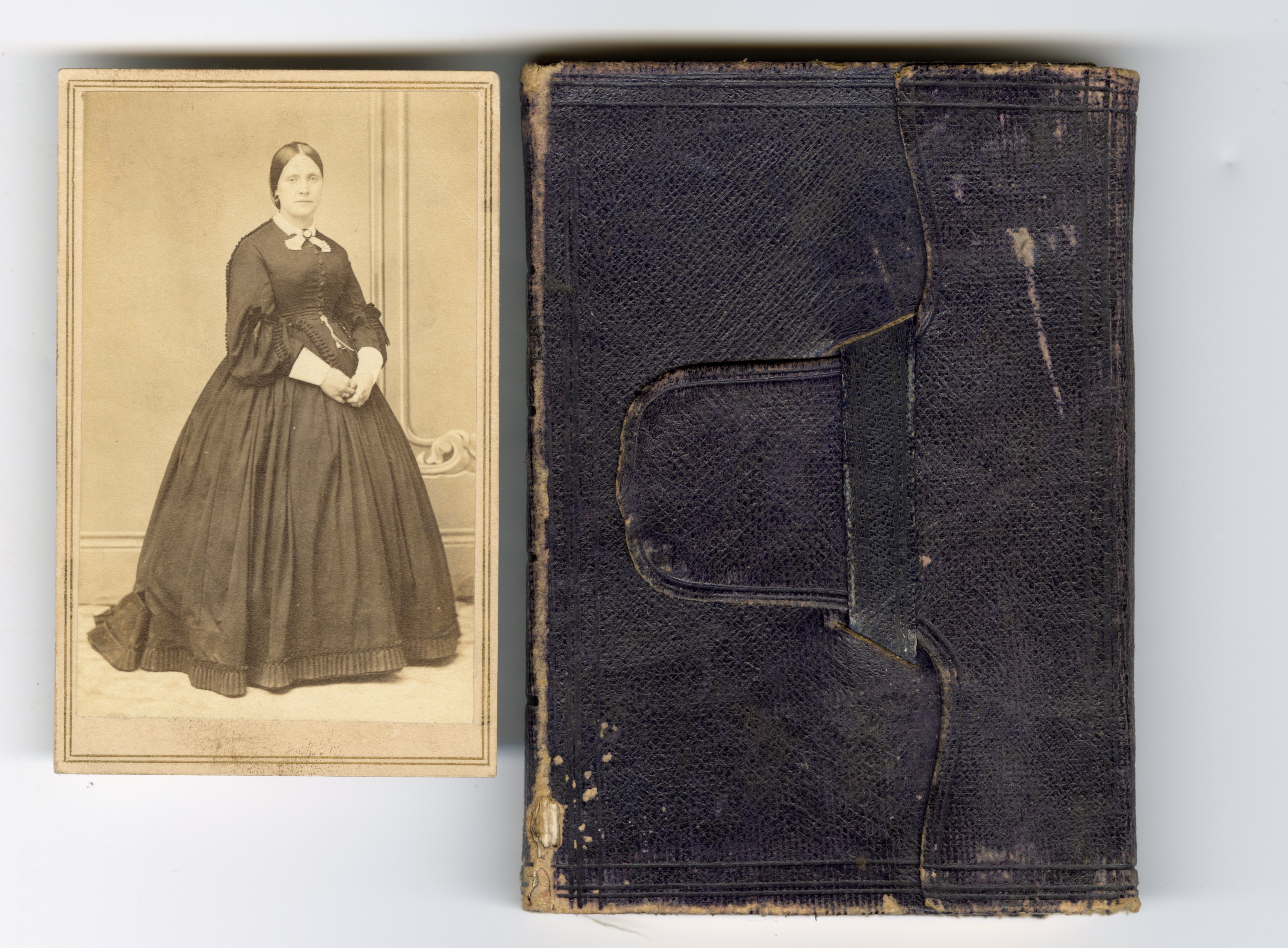
General Joseph Farmer Knipe Album
Item CDV-11909
Price: $3500.00
Description
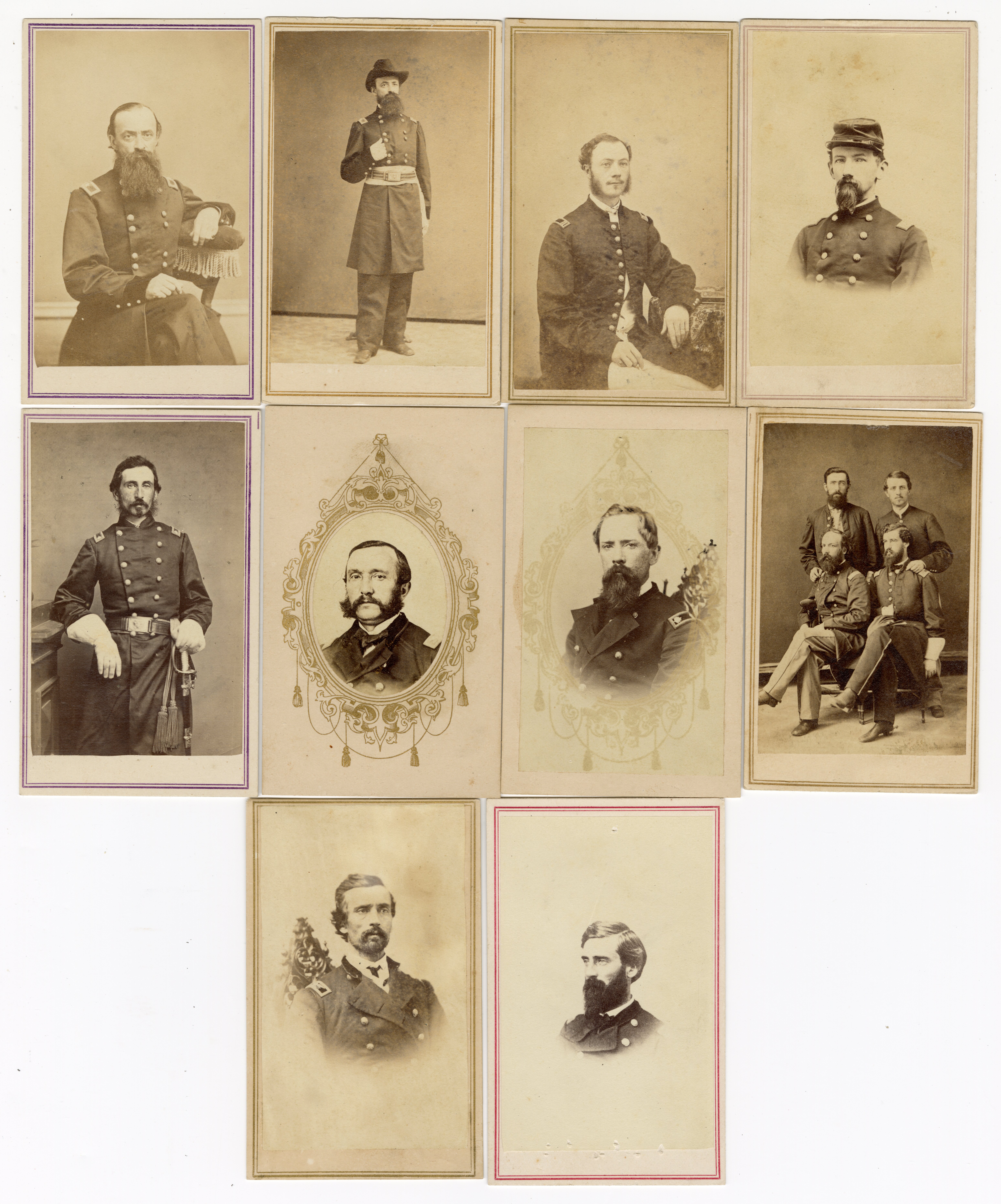
This is personal Civil War “Pocket Album” belonging to either General Joseph F. Knipe or his wife Elizabeth. It contains eleven carte de visite’s of union army officers associated with General Knipe during duty in Tennessee in late 1864 and early 1865.
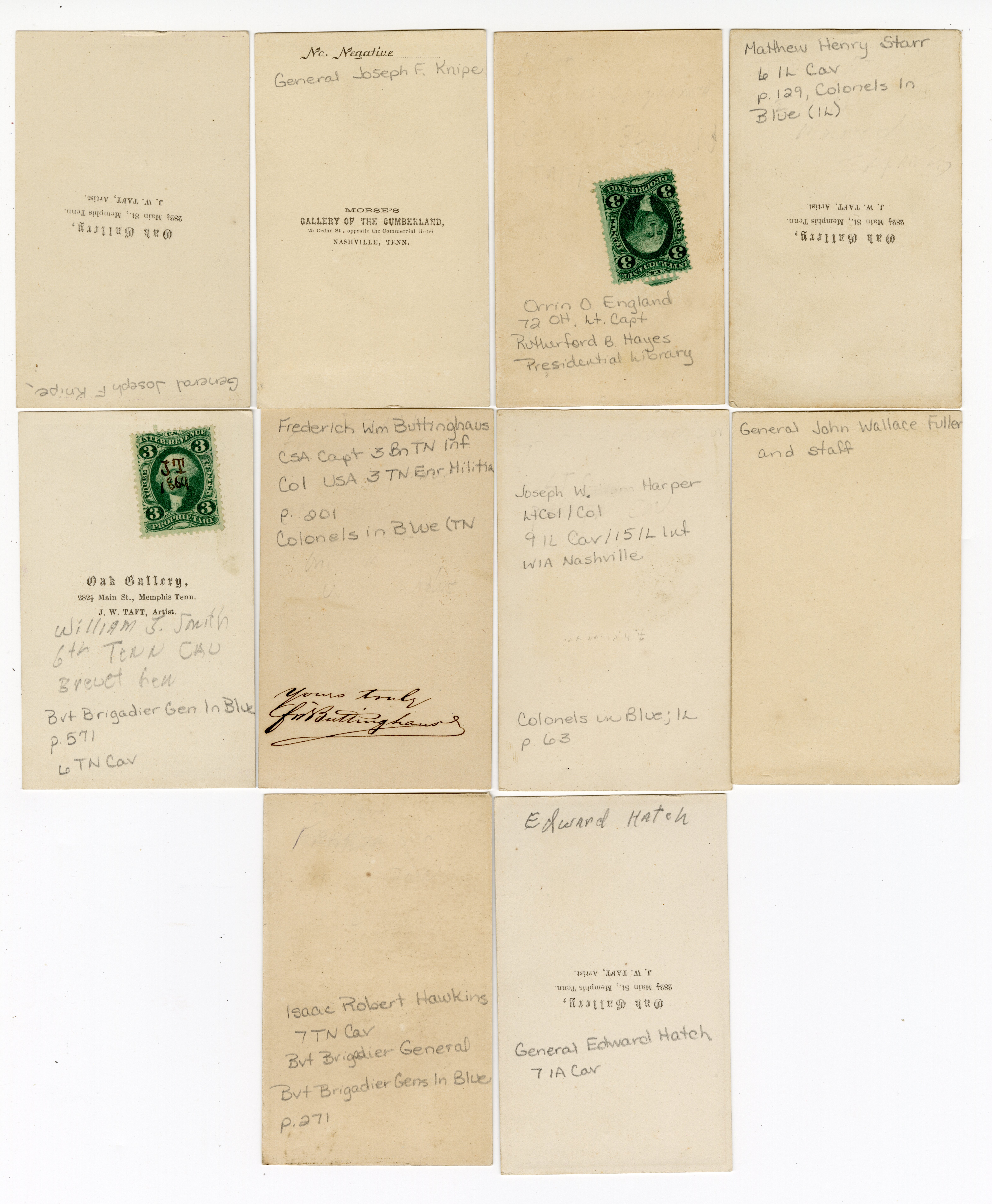
The photographer imprints on back of the images indicate the months when General Knipe assumed command of the Cavalry Corps in the Army of the Tennessee consisting of the 7th Cavalry Division and cavalry units attached to the Military Division of West Mississippi headquartered in Memphis, Tennessee.
Card No. 1 General Joseph Farmer Knipe taken by J.W. Taft at the Oak Gallery in Memphis, Tennessee. Joseph Farmer Knipe enrolled in the Pennsylvania state militia and became a major and aide-de-camp to Brig. Gen. Edward Williams, commander of the Dauphin County Militia. With the bombardment of Fort Sumter in April 1861 and the subsequent Federal call for troops to put down the rebellion, volunteers flocked to Harrisburg to enlist in Pennsylvania's newly commissioned regiments. Williams and Knipe selected the site for the state's new military training center, Camp Curtin. In September 1861, Governor Andrew Curtin commissioned Knipe as a colonel and authorized him to raise the 46th Pennsylvania Volunteer Infantry. After cursory training, Knipe's regiment was assigned to garrison duty at Harper's Ferry.
In the spring of 1862, Knipe fought in the Valley Campaign against Stonewall Jackson's forces. He was wounded at the First Battle of Winchester. He was again wounded at the Battle of Cedar Mountain. Due to the chain of command changes necessitated during the Battle of Antietam by the death of XII Corps commander Joseph K. Mansfield, Knipe took command of the brigade of Samuel W. Crawford in the first division. Crawford had taken command of the division when Alpheus Williams became acting corps commander.
On April 15, 1863, Knipe was promoted to brigadier general, backdated to November 1862. He led first brigade first division XII Corps under Alpheus Williams which saw action at the Battle of Chancellorsville. Suffering from lingering effects from his wounds and a bout with malaria, he temporarily left the Army of the Potomac and returned to Harrisburg. He took command of a brigade of inexperienced New York militia and led it in pursuit of the retreating Army of Northern Virginia following the Battle of Gettysburg.
Returning to his XII Corps brigade, Knipe went to the Western Theater and served in the Atlanta campaign. He took command of a division of Union cavalry during John Bell Hood's incursion into Tennessee, and captured 6,000 Confederates and eight battle flags in a decisive victory over the retreating Army of Tennessee following the Battle of Nashville.
Card No. 2 General Joseph Farmer Knipe taken at the Army of the Cumberland Gallery operated by A. H. Morse in Nashville.
Card No. 3 Orrin O. England, 72nd Ohio Infantry. No photographer imprint but a revenue stamp is on the back. Captain Orrin O. England, a twenty-year old tinsmith of Fremont, Ohio, enlisted in October of 1861, as a private in General Ralph P. Buckland's 72nd Ohio Volunteer Infantry and served until September of 1865. He rose rapidly through the ranks to command several different companies of the 72nd. Buckland, as brigade commander and commander of the Military District of Memphis, appointed England as his aide-de-camp and, later, assistant inspector general. In his military correspondence, Buckland expressed high regard for England's abilities, intelligence, and character. England participated in the battles of Shiloh, Corinth, Jackson, Vicksburg, and Nashville. As part of the Red River Campaign in the spring of 1864, he claimed to be the only Ohioan to have participated in the campaign.
Card No. 4 Colonel Matthew Henry Starr of the 6th Illinois Cavalry. Photographed by J.W. Taft of the Oak Gallery in Memphis. He initially served with the 9th Illinois Cavalry before becoming Colonel of the 6th Illinois Cavalry. Served on the staff of General Benjamin H. Grierson. He was mortally wounded in August 1864 in a saber duel with Nathan Bedford Forrest, during Forrest’s Raid on Memphis. Starr died of his wounds on October 1-2, 1864.
Card No. 5 Colonel William Jay Smith (later brevet brigadier general) of the 6th Tennessee Calvary. The photographer imprint is that of J.W. Taft at the Oak Gallery in Memphis. In the American Civil War, Smith served in the First West Tennessee U.S. Cavalry, later known as the 6th Tennessee Cavalry Regiment. He rose through the ranks of the regiment, largely as an associate and confederate of Fielding Hurst. Both Smith and Hurst gained reputations for using the regiment to enrich themselves during the course of the war. The regiment's most effective leader, Lt. Colonel William K.M. Breckenridge, who worked to equip and lead the regiment in most of its legitimate missions from October 1862 to October 1863, derisively referred to Smith as "Petticoat Smith" for his habit of raiding plantation homes and even taking ladies' garments for his own wife and daughters.
Smith, along with Hurst, detailed subordinates to burn and raid the homes and farms of local Confederate sympathizers. Despite labeling himself a Unionist and being a Union Army officer, Smith gained a reputation for seizing everything from furniture to mules and slaves and sending them back to his own plantation to enrich himself. His misdeeds remained largely unknown until the discovery of Breckenridge's diary in 2012 and the subsequent publication of In The Shadow of the Devil: William K.M. Breckenridge in Fielding Hurst's First West Tennessee U.S. Cavalry in 2020. This work helps to document Smith's controversial career, both wartime and postwar.
Card No. 6 Colonel Frederick Buttinghaus of the 3rd Tennessee Volunteers. There is no photographer imprint but a clear inked autograph of “Yours Truly, Fred Buttinghaus” is on the back of the image. Buttinghaus initially served as a Captain in the 3rd (Memphis) Battalion Tennessee Infantry in the service of the Confederate States of America. Battalion disbanded May 1862, on account of the surrender of Memphis. He became the United States Army Colonel of the 3rdRegiment Tennessee Enrolled Militia, District of Memphis, December 29, 1863. Described as a “low-flung, dirty foreigner” in a Memphis newspaper editor’s letter to Governor Andrew Johnson criticizing the selection of Enrolled Militia officers. He was a U.S. Volunteer Aide-de-camp, on the staff of Brigadier General Ralph P. Buckland, October 18, 1864.
Card No. 7 Lt. Colonel Joseph W. Harper of the 9th Illinois Cavalry. He was wounded at the Battle of Nashville while leading his regiment. Promoted to colonel on December 4, 1864. There is no photographer imprint.
Card No. 8 Brigadier General (then colonel) John Fuller and staff. This mint cdv was likely given to General Knipe while the two served in the Army of the Tennessee during the Atlanta, Campaign. Another possibility is that it was obtained by Knipe when Fuller was promoted to brigadier general and assigned temporary duty in Memphis before joining Sherman’s March to the Sea. Fuller had served under General Grenville Dodge for many months in 1863 and 1864 headquartered at LaGrange, Tennessee. Fuller initially commanded the 27th Ohio Infantry. There is no photographer imprint on this mint image.
Card No. 9 Colonel (later brevet brigadier general) James Loraine Geddes 0f the 8th Iowa Infantry. Wounded and captured at Shiloh, Tennessee on April 6, 1862. Sent to Libby Prison and later exchanged. Most likely detailed to assist General Knipe in his reorganizing efforts. There is no photographer imprint. (This CDV was initally misidentified as being Isaac Hawkins. Thank you to Michael Huston for correctly identifying the image as James L. Geddes).
Card No. 10 Edward Hatch volunteered for service as a private in the Union Army at the outbreak of the Civil War. He assisted in raising the 2nd Iowa Cavalry, becoming its major in August 1861. A few weeks later, he was commissioned its lieutenant colonel. In June 1862, on the promotion of Colonel Washington L. Elliott to brigadier general, he was made the regiment's colonel.
Hatch served under General Ulysses S. Grant in the South. After commanding the entire cavalry division in the Army of the Tennessee, he was appointed and confirmed a brigadier general in the spring of 1864. His gallantry in the field resulted in his further promotion to the rank of brevet major general later in 1864. The photographer imprint is that of J. W. Taft of the Oak Gallery in Memphis.
Card No. 11 Elizabeth Hagan Knipe taken at the City Gallery in St. Louis. The home base of the Knipe family was Harrisburg, Pennsylvania. Mrs. Knipe traveled frequently to visit her husband in the field.