❮
![Large Image]() ❯
❯
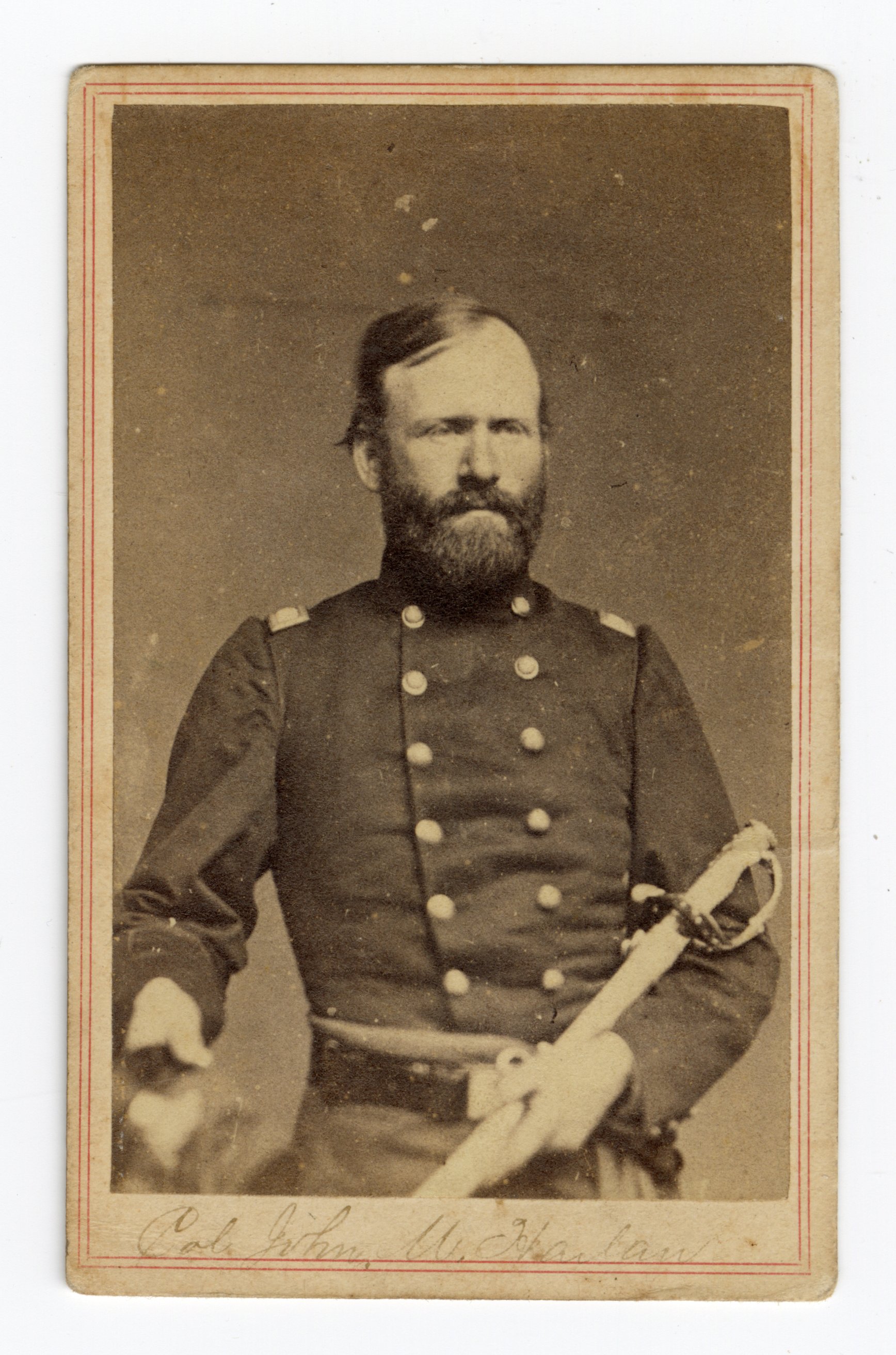
10th Kentucky Infantry
Item CDV-11718
John M. Harlan
Price: $525.00
Description
John Marshall Harlan (June 1, 1833 – October 14, 1911) was an American lawyer and politician who served as an associate justice of the Supreme Court of the United States from 1877 until his death in 1911. He is often called "The Great Dissenter" due to his many dissents in cases that restricted civil liberties, including the Civil Rights Cases, Plessy v. Ferguson, and Giles v. Harris. Many of Harlan's views expressed in his notable dissents would become the official view of the Supreme Court starting from the 1950s Warren Court and onward.When the Civil War erupted in April 1861, John Marshall Harlan was a staunch Unionist who worked tirelessly to keep Kentucky in the Union, writing several pro-Union editorials and representing the Union in state court. On August 13, 1861, after the state legislature voted to expel all Confederate forces from Kentucky, Harlan recruited and was elected captain of the newly organized Crittenden Union Zouaves, a militia unit formed to support the Union cause. By October 4, 1861, Harlan and his command were officially enrolled into the Union Army. Soon after, on October 20, 1861, he was mustered in as Colonel of the 10th Kentucky Volunteer Infantry Regiment in Lebanon, Kentucky, for a three-year term.
In September 1861, Harlan played a key role in the defense of Lebanon Junction, Kentucky, a vital transportation hub. Under General William T. Sherman, Harlan's unit worked to secure ammunition and defend strategic railroad bridges. In one notable incident, Harlan personally led efforts to transport supplies across the Rolling Fork River after Confederate forces burned the bridge, earning commendation for his resourcefulness and determination.
The 10th Kentucky Infantry soon became part of General George H. Thomas’s division. On January 19, 1862, Harlan fought at the Battle of Mill Springs, a significant Union victory that disrupted Confederate operations in Kentucky. In April 1862, his regiment participated in the Siege of Corinth, Mississippi, following the Union victory at the Battle of Shiloh.
Harlan’s most notable engagement came on December 29, 1862, during a skirmish with Confederate cavalry commander John Hunt Morgan at the Rolling Fork River Bridge, known as "Morgan's Christmas Raid." After marching his forces from Munfordville to Elizabethtown, Harlan led his troops to defend the bridge, engaging Morgan’s forces with cannon and rifle fire. This skirmish successfully disrupted Morgan’s attempt to destroy critical railroad bridges, preserving vital Union supply lines. In his official report, Harlan claimed that his command "saved the Rolling Fork Bridge and most probably prevented any attempt to destroy the bridge at Shepherdsville," safeguarding property essential to Union operations in the Western Theater.
Throughout his military service, Harlan publicly argued that the Union's goal in taking up arms was to preserve the Union rather than abolish slavery. In a wartime speech, he asserted that the war "was not for the purpose of giving freedom to the Negro." Harlan vowed to resign if President Lincoln signed the Emancipation Proclamation, which he denounced as "unconstitutional and null and void" when it took effect on January 1, 1863. However, contrary to public perception, Harlan did not resign over the proclamation.
Harlan's resignation came after the sudden death of his father on March 6, 1863, prompting him to leave the army to care for his family and resume his legal and political career. He formally resigned his commission on March 17, 1863.
He later became Attorney General of Kentucky (1863-1867).
Source: Wikipedia